Skin cancer is often underdiagnosed in Black patients, not because it is rare, but because it is frequently missed. Melanoma and other skin cancers present differently in darker skin tones, including acral lentiginous melanoma, which often appears on palms, soles, or nail beds rather than sun-exposed areas. Now more than ever, physicians are focused on stemming systemic gaps in dermatology training and AI diagnostic tools, some of which have demonstrated lower performance on darker skin due to training bias in clinical datasets.
While there’s no one-size-fits-all approach to when to biopsy, how to counsel patients, and how to reduce disparities in dermatologic outcomes, dermatology experts share their best practices.
“Just like other skin cancers, melanomas are less common in patients with darker skin tones,” said Elma Baron, MD, Professor in the Department of Dermatology at the School of Medicine at Case Western University. “But there is a type of melanoma that one should be aware of in darker-skinned individuals, and that is acral lentiginous melanoma. It’s a melanoma that usually presents on the hands/feet/nails. Although the incidence is still low, it is a clinical presentation that is more often encountered in dark-skinned than light-skinned patients.”
Often seen as dark, vertical streaks under the nails or patches on the skin, this type of cancer is different because it is not related to sun exposure. In fact, it is easily dismissed because it is found in areas such as the soles of the feet or the palms of the hands, which are rarely exposed to the sun.
“Similarly, squamous cell carcinoma in patients with darker skin more often develops in areas of chronic inflammation, scarring, wounds, or prior injury, rather than being driven by sun damage alone,” added Dr. Brandon T. Beal, MD, FAAD, Founder of St. Louis Dermatology & Cosmetic Surgery. “The key point is that skin cancer does not always follow the classic textbook pattern. Clinicians must recognize how presentation can vary across skin tones, so these cancers are not overlooked.”
James J. Chao, MD, FACS, a board-certified surgeon and Co-Founder & Chief Medical Officer at VedaNu Wellness in San Diego, said that, “historically, dermatology training has taught physicians to diagnose skin cancer by ‘pattern matching’ in our heads. He explained that darker skin tones make up only about 5 to 18 percent of images in dermatology textbooks and a much smaller proportion in medical textbooks. “Rotations in community clinics that serve patients of color, as well as dedicated teaching on dermatoscopic patterns of malignancy in skin of color, should be required during residency.”
Otherwise, Dr. Chao admitted that there is an inconsistency in how well dermatology residents are taught to recognize conditions that may mimic malignancy in darker skin types, such as dermatosis papulosa nigra or pigmented fungiform papillae. But dermatology is evolving, and the textbooks and image databases have improved skin color references over the last three to five years.
Dr. Beal concurred that today’s dermatology trainees are likely better prepared to recognize skin cancer across all skin types than any previous generation. “Historically, many teaching atlases, board exam images, and clinical case examples were disproportionately weighted toward lighter skin tones,” he said. “The shift toward digital education has been especially important because it allows trainees to learn from thousands of diverse clinical images rather than the limited number that could fit into a printed textbook or atlas.”
Dr. Beal clarified that gaps remain in the interface between dermatology and the rest of medicine. “Many patients who experience diagnostic delays are not seeing a dermatologist first,” he explained. “They are often initially evaluated by primary care physicians, urgent care clinicians, emergency medicine providers, or other non-dermatology clinicians who may have had limited formal dermatology training.”
As dermatology education improves, there are greater opportunities to strengthen frontline medical practitioners’ recognition of skin cancer and other conditions that should be referred quickly to a dermatologist.
Many patients do not know what self-advocacy means when it comes to skin cancer that doesn’t cause pain or discomfort. Knowing which diagnostics to request or when to adopt a “wait and see” approach is beyond most people’s comfort zone.
Dr. Chao said that he has yet to find any AI tool that he trusts 100 percent. “The ones that are available commercially have been trained on datasets where the distribution is heavily weighted towards lighter skin tones,” he said. “As a result, they perform significantly worse when analyzing lesions on Fitzpatrick skin types V & VI. Several studies have shown their sensitivity decreases when analyzing lesions on darker skin, which could lead to preventable diagnoses being missed.”
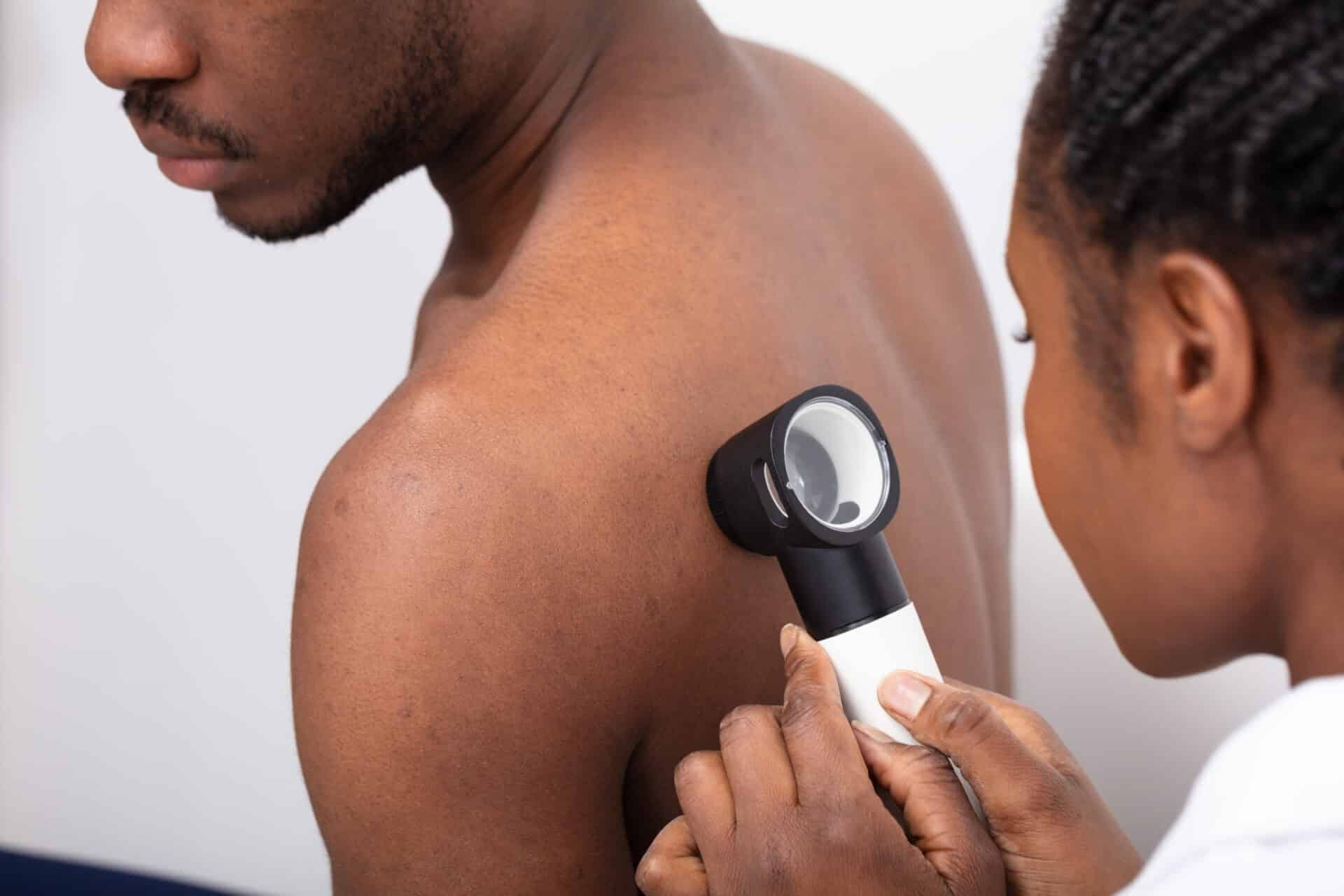
Dr. Chao added that dermatoscopy performed by an expert practitioner will always outperform AI. “Dermoscopy in the hands of trained clinicians is superior across all skin types. Reflectance confocal microscopy is another great tool that can help in ambiguous situations.”
Dr. Beal said that melanoma is more often diagnosed at later stages in Black and Hispanic patients than in white patients, and survival outcomes are worse. Some of that disparity is related to access to care, but delayed recognition also plays a role.
“The conversation I never want to have is explaining why we waited months on something that turned out to be invasive melanoma,” he said. “In my practice, if I am uncertain, I biopsy. That standard should not change based on a patient’s skin tone.”
The risk of missing melanoma is far greater than the downside of a small biopsy scar in his experience. “‘Watch and wait’ can be appropriate for lesions that are clearly benign and being followed thoughtfully over time, but it should not be the default when a clinician is uncertain,” Dr. Beal explained. In the case of lesions, he suggests sampling, but observing a possible melanoma is not good care in his opinion.
While AI alone is no cure-all, Dr. Beal said that clinical decision-support tools are useful. “OpenEvidence can quickly synthesize medical literature, though it still requires clinical judgment,” he said. “VisualDx is especially valuable because it includes a broad library of images across diverse skin types. I use it to review diagnoses, testing, prognosis, and treatment options with patients in real time. Seeing their own skin type represented helps patients understand their condition, builds trust, and improves engagement with care.”
Disparities in diagnosis and outcomes often stem from systemic issues such as access (e.g., geography, insurance, time off work) and from patient fears of not being taken seriously — especially before egregious symptoms materialize. For many reasons, Black patients may come in too early or too late to seek care for an odd mole or a weird rash.
“Being comfortable with the phrase ‘I want to biopsy this because I don’t know’ is probably the best way to improve any clinician’s dermatologic care for their patients,” Dr. Chao said.
In his opinion, performing full skin exams, including the palms, soles, nail beds, genital skin, and mucosal surfaces, should be standard practice, not just for high-risk patients or those presenting with traditional symptoms.
For physicians looking to proactively close the diagnosis gap, he suggested partnering with local community health clinics to provide low-cost or free skin cancer screenings to help identify patients early.
Dr. Beal summarized it well, saying that reducing disparities requires better education, better access, and greater clinical vigilance.
By subscribing, you consent to receive emails from BlackDoctor.pro You may unsubscribe at any time. Privacy Policy & Terms of Service.
Are you a healthcare professional? Register with us today!