
When a Black man opens up to express his emotions, it’s important that someone listens.
For generations, many Black men have been taught to be strong, self-reliant, and capable of handling problems on their own. While resilience can be a valuable trait, constantly feeling pressure to appear strong can also make it difficult to acknowledge emotional distress or ask for support when it’s needed. As a result, depression, anxiety, grief, and burnout may go unnoticed, not because they aren’t present, but because they often show up in ways providers may not expect.
According to the Centers for Disease Control and Prevention (CDC), 8.5 percent of men report daily feelings of anxiety or depression, yet only 41 percent have taken medication or recently spoken with a mental health professional about those feelings.
For Black men, cultural expectations, stigma surrounding mental health, and historical mistrust of healthcare systems can create additional barriers to discussing emotional well-being. This means that when a patient says, “I’m good,” it isn’t always the full story. Providers may need to look beyond the words themselves and consider what else may be happening beneath the surface.
A number of Black men are raised with messages that encourage independence, such as “You’re a big boy, you can do it” or “Toughen up.” Over time, these expectations can carry into adulthood and even healthcare settings, making it difficult to recognize emotional struggles or communicate them openly to providers.
“For many Black men, the idea that you should always be self-reliant keeps them trapped in a spiral of unintentional self-sabotage,” said Jor-El Caraballo, LMHC, and author of Mindful Meditations for Black Men.
According to Caraballo, this belief can lead men to minimize their concerns, invalidate their own feelings, or deny that anything is wrong altogether.
“Over time, this kind of hyper-independence can lead to ongoing confusion about your distress, isolation from others, and worsening mental health,” he explained.
A patient saying “I’m fine” does not always mean they are actually okay. In fact, Caraballo says the phrase itself can invite providers to ask additional questions. “‘I’m fine’ is one of those reflexive phrases many of us say because that’s the socially acceptable thing to say,” he said. “It almost always warrants repeating or rephrasing the question.”
“Are they saying they’re fine and shaking their leg the entire time? What if their face looks tight and not relaxed?” Caraballo asked. “Looking for these behavioral signs can be helpful indicators to gently coax further for someone who may be distrusting of providers or hesitant to express their vulnerabilities.”
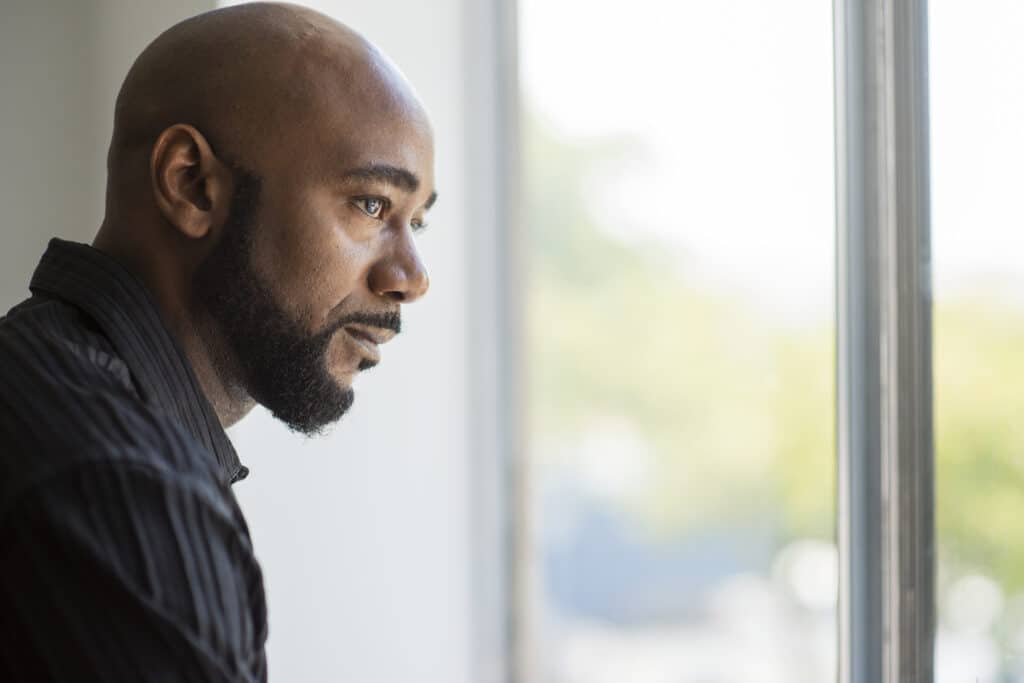
Depression and anxiety do not always look the same from person to person. While some patients may openly display emotions, others may show signs through their behaviors.
“Unfortunately, Black men have learned how to perform being ‘okay’ very well,” Caraballo said.
Because of this, providers may overlook signs such as:
Caraballo noted that irritability and anger can sometimes be more useful indicators of distress than sadness or a noticeably low mood.
Creating a safe environment is the key, starting with treating Black male patients as a person rather than focusing on symptoms.
“The single best thing a provider can do is prioritize their Black male patients as full human beings they are curious about and invested in helping,” Caraballo said.
He recommended openly communicating a desire to help and acknowledging the courage it takes for a patient to seek care.
“Verbally acknowledging the desire to help, and acknowledging the patient’s bravery to come in, is a good way to start building a relationship where a patient can settle in, share more, and ultimately get the support they need,” he added.
Simple actions such as maintaining eye contact, asking open-ended questions, and creating space for honest conversations can go a long way toward building rapport and trust.

One of the biggest misconceptions surrounding Black men’s mental health is that a calm demeanor means everything is okay.
“There is a problematic and documented history of the minimization of Black pain in healthcare,” Caraballo said.
As a result, providers should recognize that some Black men have spent years downplaying their struggles before seeking help. By the time they arrive in a healthcare setting, their distress may be more severe than they are willing or able to express.
“It is important that providers communicate the very real challenges to mental health and how they contribute to changes in quality of life and functioning,” Caraballo explained.
Ultimately, as conversations around mental health continue to evolve, there is hope that more Black men will feel comfortable sharing how they are truly feeling. For providers, that starts with approaching Black male patients with curiosity, empathy, and cultural humility. When a patient says, “I’m fine,” the most important thing a provider can do is ask one more question.
By subscribing, you consent to receive emails from BlackDoctor.pro You may unsubscribe at any time. Privacy Policy & Terms of Service.
Are you a healthcare professional? Register with us today!