

Being a Black doctor has always been a revered position, but it has also come with challenges. There is isolation and often racism in the education and medical systems.
Dr. Dale Okorodudu, a Dallas-based pulmonary and critical care physician, established Black Men in White Coats, an organization that provides exposure, networking, and mentorship to Black youth interested in medicine to increase the number of Black men entering the medical field.
For more than a decade, BMWC has hosted dozens of youth summits across the country in partnership with medical schools and organizations, and supported by many individual Black healthcare practitioners who were moved by the mission.
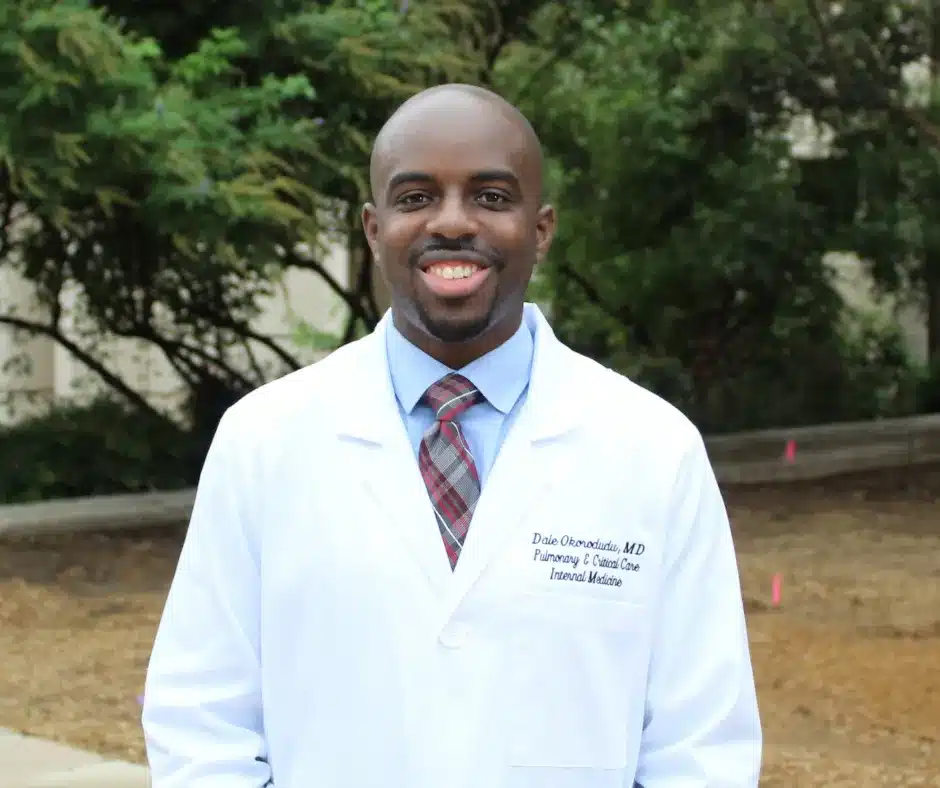
The images were striking. A sea of Black men donning white monogrammed medical coats, representing the highest levels in medicine, and setting an example for the next generation of Black and brown middle- and high-schoolers. The healthcare providers gave back at those summits – but they also shared how they received something meaningful, often by sharing their personal experiences growing up as “the only” or by enjoying the camaraderie of seeing their colleagues in one space. The underlying message for BMWC, the doctors, and teens alike — representation matters.
In recent years, however, programs like BMWC have faced increased backlash and political pressure. Last year, Dr. Okorodudu announced that some youth summits were canceled after some partners withdrew their support amid growing federal scrutiny of diversity, equity, and inclusion (DEI) funding.
Despite these challenges, several BMWC youth summit partners have remained committed to the mission, allowing the summits to continue this year.
Building a pathway to bring more young people into the field is what Dr. Okorodudu says has and remains the center of his mission, and why, despite the challenging DEI rollbacks from this administration, the loss of sponsors, and the difficulty in keeping the events going. Dr. Okorodudu shares that the need to be there as examples for future generations of clinicians is as great today as it was when he launched the idea in 2013.
BlackDoctor Pro caught up with Dr. Okorodudu recently, in the days leading up to his Los Angeles Youth Summit, which drew an estimated 2,000 young people, to learn more about the origins of BMWC, the recent challenges, and why initiatives like these remain critical to diversifying the future of medicine.
Dr. Okorodudu: In 2013, I was a resident physician [at Duke], and I saw an article that said the number of Black men [who applied] to medical school in 2011 was lower than in 2002.
I got my brother, who was a fellow at Duke, and a medical student who was one of our friends, and said, ‘Hey, let’s do something about this. Let’s make a video.’
I propped my cellphone up on my wallet, and we filmed this video with three Black guys wearing white coats, and said, “Let’s call it `Black Men in White Coats.’” We put it up on one of my friends’ YouTube channels, and it got a good amount of views. [And,] people started talking about it.
We started mentoring at a nonprofit and eventually produced summits, a documentary, and books. The idea was to do anything we could to turn the tide and get more Black young men going into the field of medicine.
Dr. Okorodudu: Some were canceled because our partners did not renew. It’s a political climate, and many people misunderstand our intentions in trying to get more representation in medicine.
They think you’re trying to increase diversity and take away the merit from getting to medical school — that’s not what it is at all. What we’re trying to do is make medicine better.
Your patients don’t care what your MCAT score was or what grade you made in medical school. I’ve never had a patient ask me, “How were your grades in medical school?” They say, “Please do everything you can to save my wife or my husband, or please make sure you call us back in to check on us.” Those are the things they care about. That’s the merit of medicine.
With [the DEI debates] and the political climate, it got to a point where some of our partners felt too much pressure and had to withdraw. They were getting concerned about losing federal funding.
If they ran the summits, those weren’t renewed. We also had two of them canceled, including one that was canceled a week before.
Dr. Okorodudu: This year has been similar for us. We haven’t made much of a push to bring on new summits, given the climate, but our partners have stuck with us and realize the importance of this.
In Dallas, we just had the best summit that we’ve ever had. It’s probably the best Black Men in White Coats summit to date. The mission is still going strong.
[My partners] have held steadfast. They believe in the mission, and they supported us, which allowed us to put on this past phenomenal summit.
[One of my partners] has been on board for four years now, and they’re heavily committed. They’ve been around for the same social pressures, but they stand steadfast. They’re not just standing for the mission — they understand the importance of representation in medicine. They’ve put on one of our best events.
Dr. Okorodudu: It’s all about having a seat at the table. The importance of programs like Black Men in White Coats and others is to make sure we have representation, so we can bring ideas from all facets. We want ideas coming from everybody to make things better, but also to make sure we’re taken care of.
Dr. Okorodudu: Our strategy hasn’t changed. Whatever we do, we’ll do our best. We’re still going full steam with our partners. At some point, we will start bringing more of our partners back in. We’re considering the right times with the current climate and strategizing appropriately for when we do these things.
Dr. Okorodudu: Thank you to our partners, specifically the leadership – the hospital presidents, CEOs, and boards have a good understanding of why this is so important and are thinking long-term for the betterment of their communities. That takes courage and wisdom, so I’m grateful for the leadership.
Have a pathway program you want to tell us about or a first-person story about being a medical professional today? Share it with us at [email protected].
By subscribing, you consent to receive emails from BlackDoctor.pro You may unsubscribe at any time. Privacy Policy & Terms of Service.
Are you a healthcare professional? Register with us today!