By Calbeth Alaribe, DMSc, MPH, PA-C
I was 14 years old when a doctor gave my pain a name: endometriosis — a condition in which tissue similar to the lining of the uterus grows outside it, causing chronic pain, inflammation, and, for many women, complications that extend far beyond the monthly cycle. As I got older, the chronic pain and other endometriosis symptoms didn’t fade — they got worse. And somewhere in that worsening, I began to wonder what pregnancy might look like for a body already carrying this much. I started asking a question no one around me could answer: “If I ever became pregnant, what would happen to my body?”
Nobody told me. Not because they were hiding something, but because they didn’t know. I would later discover, after being in clinical practice and three years of doctoral research, that the reason they didn’t know is that no one had ever bothered to study it — at least not in women who looked like me.
Fast forward, I grew up and became an OB/GYN hospitalist physician assistant. I stood in labor and delivery rooms, managed hypertensive emergencies, and watched Black women navigate a healthcare system that had never studied their specific risks with intention. And the question I had carried: “What happens to a Black woman with endometriosis when she becomes pregnant?” This question followed me into every room.
Eventually, I stopped waiting for someone else to answer it.
Endometriosis affects roughly one in ten women of reproductive age. It’s also one of the most underdiagnosed conditions in medicine, with an average delay between symptom onset and diagnosis of seven to ten years. For Black women, that delay is even longer. Research shows that Black women are nearly 50 percent less likely to be diagnosed with endometriosis than white women — not because they experience the condition less, but because their pain is more likely to be dismissed, minimized, or misattributed to other causes.
At the same time, Black women face a catastrophic disparity in maternal outcomes. They’re two to three times more likely to die from pregnancy-related causes than white women in the United States. And when it comes to preeclampsia and eclampsia — dangerous hypertensive disorders that can arise during pregnancy, causing organ damage, seizures, and in the worst cases, death — that disparity widens to five times the risk.
These two realities existed alongside each other in the literature for years. However, researchers had not intentionally assessed how they impacted Black women differently. Race wasn’t at the center of the question; rather, it was footnoted or adjusted away.
To understand why endometriosis and preeclampsia belong in the same conversation, you must understand what endometriosis does to the body beyond the uterus.
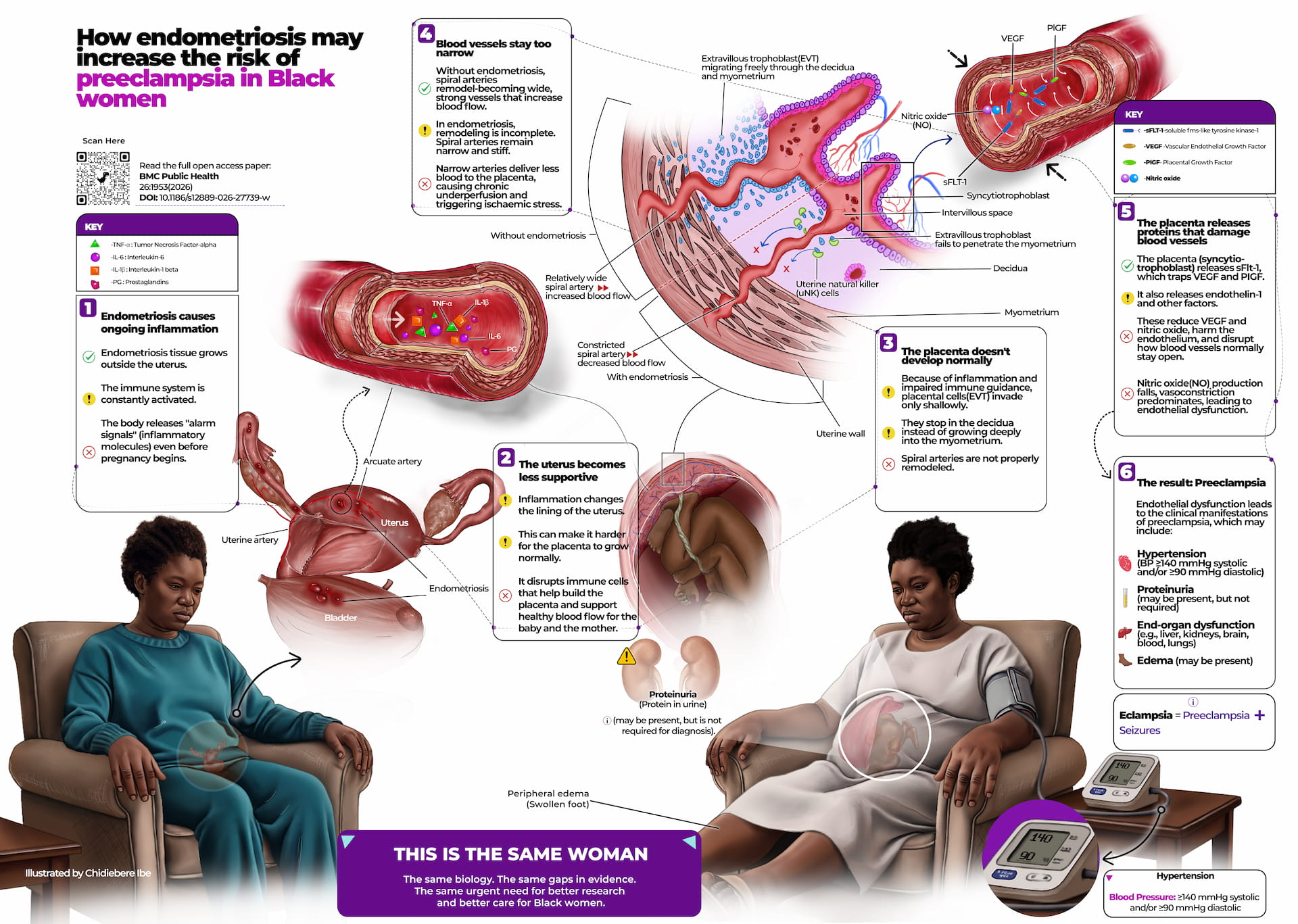
Endometriosis is not simply a reproductive condition — it’s a systemic inflammatory disease. When endometrial-like tissue grows outside the uterus, it triggers chronic immune activation throughout the body, damaging blood vessels over time and placing long-term strain on the cardiovascular system, which is why research has increasingly linked endometriosis to elevated risk of heart disease, stroke, and hypertension.
Preeclampsia, at its core, is a vascular disorder. It develops when the placenta fails to establish healthy blood flow early in pregnancy, triggering systemic hypertension that can damage the kidneys, liver, brain, and heart. The inflammatory terrain endometriosis creates is precisely the kind of environment that makes healthy placental development harder to sustain. One condition biologically primes the body for the other.
Existing research in non-race-stratified populations has already begun to reflect this. Studies have found that women with endometriosis face a modest but significantly higher risk of preeclampsia, with odds ratios between 1.19 and 1.20. That association exists. What has never been examined is what that association looks like in Black women specifically, who arrive at pregnancy already carrying a disproportionate burden of inflammation, vascular stress, and diagnostic delay.
Researchers use the term allostatic load to describe the cumulative physiological toll that chronic stress places on the body. For Black women, that load is often elevated before pregnancy even begins. Not due to biology, but because of the lived reality of navigating racism in healthcare, housing, employment, and daily life. The chronic inflammation from endometriosis lands on a body that is frequently already managing several stressors. The combination creates a risk profile that is clinically meaningful and structurally produced.
That risk profile has never been formally studied, which is what my research set out to document.
My scoping review, co-authored with Dr. Kimberly D. Sapre and published in BMC Public Health in May 2026, set out to find every U.S.-based study that examined the relationship between endometriosis and preeclampsia or eclampsia in Black women using race-stratified outcomes. We searched nine databases, identified 370 peer-reviewed records, and chose 19 of them to review in depth.
Not one met our inclusion criteria. No eligible studies existed.
That absence is not a footnote — it’s a finding. It tells us that despite decades of research on endometriosis, preeclampsia, and documented racial disparities in maternal outcomes, the medical field has never produced a single U.S. study asking what the relationship between these two conditions looks like specifically for Black women.
Part of the reason is methodological. Many studies that include Black women do not actually study them. They adjust for race as a statistical variable, treating it as background noise to be controlled rather than as a central lens through which disparities must be understood. When you adjust for race in a statistical model, you erase the mechanism. You build a picture of medicine in a world where racism does not shape who gets diagnosed, who gets believed, and who gets studied. That is not the world Black women are living in. This is not a failure of individual researchers alone. It’s a failure of how health professions education has taught generations of clinicians and scientists to think about race, risk, and whose bodies are centered in evidence.
The result is a research infrastructure that produces findings that appear universal but are not. Black women pay the clinical price for that gap every time they sit across from a medical provider whose care is guided by evidence that was never built for them. I’m naming this gap not only as a clinician and a researcher. I’m carrying it as an advocate, someone willing to step outside the academy and put a name to what the data has been too quiet about for too long. Every time I speak about this research, I’m asking our health professional education system and our research infrastructure to do what they exist to do: serve the health of everyone in our society, not just the populations who have historically been centered in it.
The research does not yet exist to tell us exactly how endometriosis raises preeclampsia risk in Black women specifically. But the absence of that research is not the absence of risk. Black women and their communities have long held knowledge about their own bodies that institutions were too slow to validate, and that knowledge is worth acting on. If you have endometriosis and you are pregnant or planning a pregnancy, here is what you can do today.
I’m still carrying the question I had at 14 years old, but I carry it differently now.
I carry it as a researcher who has documented what the field refused to look at. I carry it as a clinician who has stood in rooms where the stakes of that absence are not abstract. And I carry it as a Black woman who knows that the gap between what has been studied and what we need to know is not a gap in interest — it’s the result of a decision about whose lives are worth investigating.
Endometriosis and preeclampsia are connected. We don’t know if there is causation yet, but we do know there is a connection. The biology is clear. The disparity is documented. And for Black women, who face the highest risk and the least research, that connection has been invisible for too long.
That paper is now published and is open access — free for anyone to read. It’s one step in a longer process of repair, restoring to Black women the evidence base that decades of exclusionary research withheld. And it’s a beginning, not an end.
We found the gap. Now let’s close it.
Calbeth Alaribe, DMSc, MPH, PA-C
Calbeth Alaribe is an OB/GYN Hospitalist Physician Assistant, published researcher, and nationally recognized health equity leader. She is the author of a scoping review on endometriosis and preeclampsia in Black women published in BMC Public Health (2026), and a MIT Hacking Racism in Healthcare Competition Winner. She advises startups, health tech companies, universities, and nonprofits on women’s health inclusion and equity, and speaks nationally on Black maternal health, research methodology, and reproductive justice. She has a master’s degree in public health from Emory University, a Physician Assistant degree from Morehouse School of Medicine, and a doctorate in medical science from Shenandoah University.
The Social Mission Alliance For Us All Campaign is a vehicle to activate the community health care professionals, educators, trainees and the communities they serve to advance structural changes aligned with SMA’s vision for health professions training: health professions education in which social mission is present, prominent, and valued to drive health equity and improved health for individuals, families, and communities. A part of the For Us All campaign is a media narrative effort that will highlight the material impacts these kinds of advancements have on patients, communities, clinicians, learners, and educators. These stories are a template for what we should be striving for in our healthcare and health professional training institutions. Black Doctor dot Org is a proud For Us All campaign coalition partner and will be publishing essays that share a vision of healthcare that advances health for all members of society.
By subscribing, you consent to receive emails from BlackDoctor.pro You may unsubscribe at any time. Privacy Policy & Terms of Service.
Are you a healthcare professional? Register with us today!